

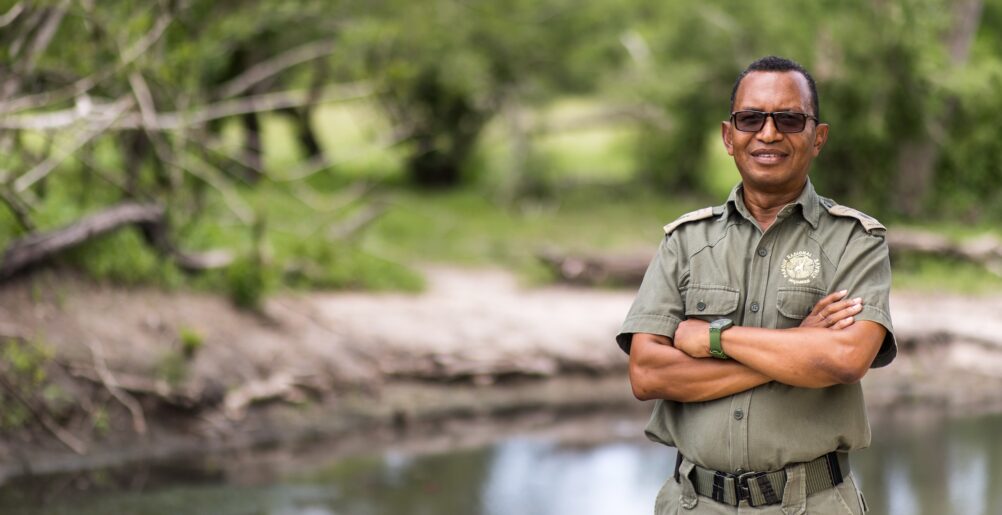
Nearly two decades at Zinave
António José Augusto Abacar is a Mozambican conservationist with more than 30 years’ experience. He served as warden of Zinave National Park from 2006 to 2012 and again from the beginning of 2017 until his retirement. In 2025, he received Mozambique’s Medal of Merit for the Environment in recognition of his contribution to environmental preservation.
As he retires, we asked him what stays with him from nearly two decades at Zinave, what those years taught him, and what he hopes the next generation will protect.
When you first arrived at Zinave in 2006, what did you find?
When I first stepped into Zinave National Park in 2006, it was difficult even to see a warthog or a duiker in bright daylight. Decades of intensive illegal hunting and wartime poaching had completely decimated the park’s large animal population, and it had become known as a “silent park.”
The lions, hyenas, elephants, buffalo, rhinos, sable, eland and giraffes were gone. The wildlife had disappeared, but the beauty of the landscape remained, with its ancient baobabs, mopane, miombo, knobthorn and yellow fever trees.

What were those early years like as warden?
Zinave lacked staff, rangers, infrastructure and basic equipment for patrols and management. I remember using my own vehicle for anti-poaching patrols at the beginning.
There were also communities living within the core area of the park, with livestock, farming and fishing camps along the Save River. Honey collection and palm wine production were also important activities. There was no access control at the main entry points, or over movement within the park. I knew there was a long road ahead.
What did those years teach you about where recovery has to begin?
You cannot restore a park without working with the people who live around it. People need opportunities and livelihoods that allow them to benefit from a healthy park whether through farming, chicken production, beekeeping, employment or access to services such as schools and water.
At the same time, you have to rebuild the foundations of the park itself: staff, protection, equipment and infrastructure. It takes sustained financial and political support from government and partners, and it takes patience. Much of the work is invisible for years before people begin to see the results.
What did you feel when you saw the first rhino released in 2022?
I felt deeply emotional. After so many years battling illegal logging and poaching, it felt like proof that our sacrifices had been worthwhile and gave me hope that Zinave would continue to thrive.
The return of rhinos also meant that Zinave had become Mozambique’s first Big Five national park. Knowing I had been part of that journey brought me enormous pride.
The return of a lion in 2021 left you with a particularly memorable story. What happened?
Having first walked through an almost empty park in 2006, the natural return of a lion was a powerful sign of how much had changed.
The first photographic evidence was captured on a camera trap I had personally set. The lion knocked the camera down, but the memory card survived. It contained a single image of the male lion, removing any doubt that a lion had returned to Zinave after roughly 40 years.
That moment meant a great deal to me. We had spent years bringing wildlife back to Zinave. The lion had come back on its own.

Looking back, what are you most proud of?
I believe the park cannot thrive without its neighbours. I am proud that the recovery of Zinave is beginning to create real economic opportunities for people living around it.
Growing tourism can create long-term employment and local business opportunities, while continued engagement has helped build stronger relationships between the park, communities and local government. For conservation to last, people need to see value in having a healthy national park as their neighbour.
What do you hope the next generation understands about Zinave?
Be prepared to inherit and protect Zinave as a national treasure. You are the future guardians, biologists, veterinarians, hospitality managers and policymakers.
See the park as a place of learning, and let Zinave stand as proof that what has been lost can be restored through dedication and partnership.
How do you feel about leaving Zinave now?
I retire with the certainty and conviction that Zinave National Park will continue to thrive under the joint management of Mozambique’s National Administration for Conservation Areas and Peace Parks Foundation.

