

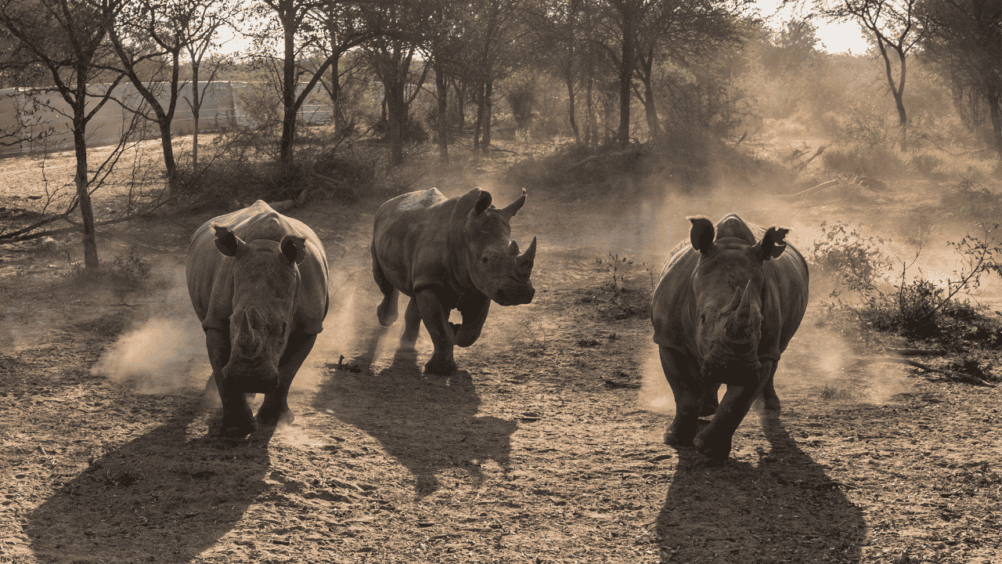
Mozambique’s first Big Five national park wasn’t created when nine white rhinos stepped out of their crates. By then, the hard work had already been done.
A decade of rebuilding a protected area. Three years establishing viable rhino populations. Months securing permits. Thousands of hours of planning. Hundreds of people working across two countries. Moving the rhinos was the final step.
The real story started long before the crate doors opened. It involved government agencies, conservation organisations, veterinarians, logistics specialists, security teams and private sector partners working across two countries.
Most people experience a wildlife translocation as a single moment. A truck arrives. A gate opens. An animal walks free.
What they do not see are the permits, planning meetings, security arrangements, veterinary checks, border clearances, specialised equipment and years of investment required to make that moment possible.
The numbers reveal the story behind the milestone.
The translocation of nine female white rhinos from South Africa’s Manketti Game Reserve to Mozambique’s Zinave National Park marked the culmination of a multi-year effort to establish viable founder populations of both white and black rhinos, securing Zinave’s status as Mozambique’s first Big Five national park.
For Exxaro, the journey began years earlier. Planning started in 2023 with the relocation of rhinos from Botswana into South Africa. After arriving at Manketti in August 2024, DNA samples were collected as preparations began for their eventual move to Mozambique. Around 20 Exxaro employees and four contractors supported different stages of the process.
Yet the most significant number behind this milestone was not nine rhinos, 1 650 kilometres or 48 hours on the road. It was ten years.
Zinave could only receive these rhinos because of a decade of work to rebuild a protected area that had lost much of its wildlife during years of conflict and neglect. Government leadership, long-term partnerships and sustained investment restored wildlife populations, strengthened protection and laid the foundations for a national park capable of supporting biodiversity, tourism and local livelihoods. The journey to Zinave officially began in January 2026.
That is when the permit process started, a three-to-four-month administrative marathon involving ministerial approvals in South Africa and Mozambique, veterinary clearances, import and export permits, CITES documentation, customs exemptions and banking approvals.
One Conservation Solutions staff member worked on the process full-time, supported by two to three part-time assistants. Behind the scenes, Peace Parks Foundation, Mozambique’s National Administration for Conservation Areas (ANAC) and the Mozambique Wildlife Alliance helped navigate the complex approval process.
Meanwhile, at the Manketti boma, the rhinos were never left alone with dedicated protection teams who monitored the animals around the clock.
The day before loading, the trucks arrived early. A full safety briefing brought together a team of about 45 people, including veterinarians, wildlife specialists, logistics specialists, Exxaro representatives, Peace Parks staff and media crews to review every step of the operation.
Before dawn the following morning, the final preparations began.
For the capture of each rhino, a team of eight to ten people helped sedate the animal, fit it with specialised monitoring technology and guide it safely into an awaiting crate. Nearly 20 people were directly involved in the loading operation.
In just two hours, nine rhinos were loaded into purpose-built steel crates weighing one tonne each. Specially designed and fabricated for rhino transport, the crates allowed the animals to eat, drink and travel safely throughout the journey. They formed a critical part of the operation’s animal welfare and safety measures.
The convoy then began a 1 650-kilometre journey across two southern African countries.
Only two trucks carried the rhinos. A third travelled as a contingency vehicle in case of a mechanical breakdown.
Six drivers shared the journey, while a support team consisting of a veterinarian, wildlife specialist and mechanic travelled in the convoy.
The rhinos needed 225 kilograms of lucerne and 720 litres of water to sustain them during the 40-to-48-hour journey.
For nearly two days, the convoy moved steadily towards Zinave.
The border crossing represented one of the operation’s greatest risks.
A standard freight truck can spend up to 24 hours waiting to cross an international border. For live animals, such delays can be catastrophic.
Through extensive advance planning and coordination between authorities in both countries, the convoy crossed the border in approximately 90 minutes, minimising stress on the animals. On the South African side, a Department of Home Affairs official was waiting for the convoy, ensuring passports and documentation were processed immediately.
A private security company accompanied the convoy, while on the Mozambican side a private border agent facilitated entry. Police, traffic officers and ANAC personnel then escorted the trucks through Mozambique to Zinave.
“This translocation exercise took a lot of logistical planning and coordination. We had to make special arrangements for the trucks to come through the border and for the inspections to take place. The priority was to get the animals through the border as fast as possible,” said Bernard van Lente, Head of Operations and Development at Zinave National Park.
“It was a very satisfying feeling once it was done, because every piece of the puzzle came together.”
Long before the convoy arrived, Zinave was already waiting.
Inside the park’s rhino sanctuary, a team of ten people spent up to eight weeks constructing an acclimatisation boma, preparing access roads and installing the infrastructure needed to receive the animals safely.
Feeding stations were stocked with lucerne, pellets and water in preparation to receive the rhinos, ensuring they could rest, hydrate and recover from the journey before entering the wider sanctuary.
After nearly two days on the road, the rhinos arrived safely and in good health. A team of five people used a hydraulic crane to offload the crates into the boma. The process took 90 minutes. Veterinarians inspected each animal before the crate doors were opened.
For the next 24 to 48 hours, staff monitored the rhinos continuously. Food and water had already been positioned inside the boma, while specialised monitoring systems allowed teams to track their welfare and movements.
“The first translocation in 2022 was a lot more difficult, but now we know what works,” said van Lente. “We have not lost a single rhino, which is an incredible achievement.”
The arrival of the nine females brought Zinave’s white rhino population to 39, completing the founder population and joining 22 critically endangered black rhinos already established in the park.
The nine rhinos may be the most visible symbol of Zinave’s recovery. But the real achievement lies behind the numbers: a decade spent rebuilding Zinave into Mozambique’s first Big Five national park, creating opportunities for tourism, jobs and local businesses, and ensuring that future generations can continue to benefit from a thriving protected area.
