

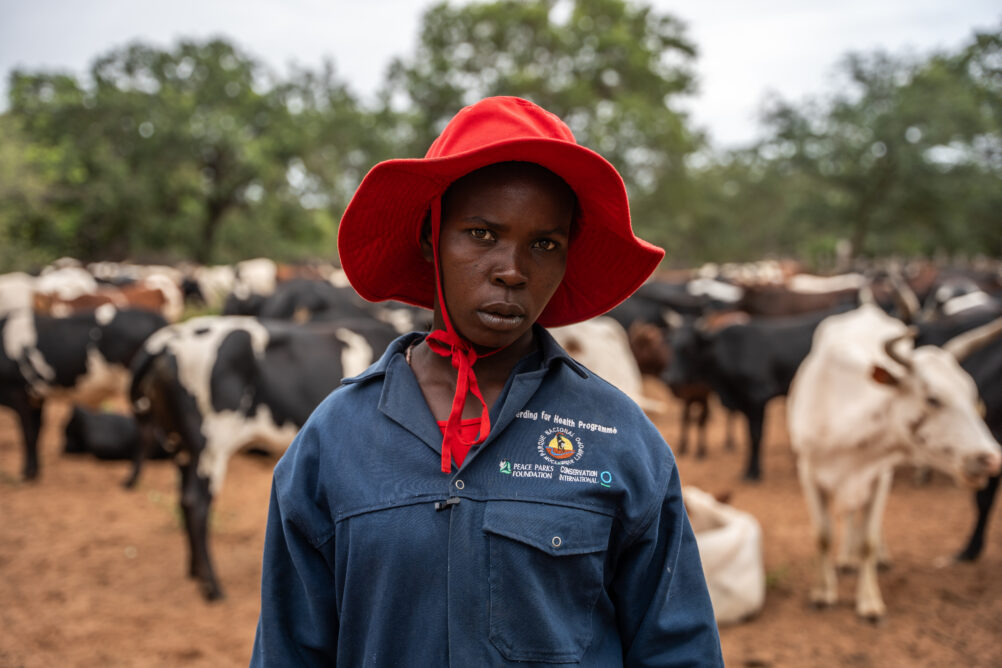
In many communities across southern Africa, traditional roles limit women’s participation, especially in agriculture and livestock management. However, through the Herding for Health programme, a partnership between Conservation International and Peace Parks Foundation, women are making significant impacts in areas typically dominated by men.
Today, we celebrate Elizabete Matsimbe, whose strength, resilience, and determination inspire those around her.
After the passing of her husband, who had been involved in the Herding for Health programme, Elizabete faced significant hardships. Pregnant and with a young child to care for, she was left without an income. Against all odds, she stepped into her husband’s role in the programme, determined to support her family.
When she joined Herding for Health in 2022, Elizabete had just four cattle. With the support and resources provided by the programme, she worked hard to grow her herd to nine cattle, demonstrating her dedication to her family’s future. Elizabete used her income to build her house so she could provide a safe environment for her children. She can now care for her family’s basic needs, and support her six-year-old daughter’s education.
Elizabete did not stop there. She purchased two goats, further diversifying her sources of income. She is a living testament to how the Herding for Health programme empowers women to lead, support their families, and create sustainable livelihoods.
“The poverty which caused so much suffering to me and my children is now over. I will never suffer like that again, nor will my children.” Elizabete shares.
Growing the herds
Fatima Mbiza, a 50-year-old mother of eight, lives in the Tchai-Tchai community on the outskirts of Banhine National Park in Mozambique. Before joining the Herding for Health programme, she struggled to manage her cattle and to provide for her family. Her youngest son had to herd cattle instead of attending school as finding a herder was a challenge due to financial constraints.

“Before, it was complicated, I was often accused of the animals getting into the fields where they ate and destroyed the farmers’ crops,” Fatima recalls. “But now, things are different.”
When Fatima joined the programme, she had 27 animals. Thanks to Herding for Health’s support, her herd has grown to 36 cattle. She was able to sell seven of her animals over the past year, which brought in much-needed income for her family.
“I am so grateful for the Herding for Health programme. It has helped me improve my livestock management, and my son is now back in school. The cattle are healthier thanks to the guidance from the technicians, and I have time to focus on my other rural activities,” she explains.
Fatima’s story is one of transformation and empowerment. She feels secure knowing her cattle are well-managed and her children’s future is brighter.
Beyond her own success, Fatima sees the bigger picture.
“I want to see this programme grow, not just for me, but for others. It’s important for young people and women like me to have the opportunity to earn a living and take care of our children,” Fatima adds.
Her dedication and leadership demonstrate the far-reaching benefits of Herding for Health, which helps not only restore the land but also empowers individuals and communities to thrive sustainably.
The Herding for Health model has been successfully tested across all key rangeland ecosystems and is being applied to restore and improve the management of 100 000 km2 of rangelands across seven countries in Africa supporting 5 533 farmers and benefitting 15 430 people.


