Shared governance, shared goals
Peace Parks works towards a future where people live in balance with nature. By including all stakeholders in a landscape, and placing local people at the heart of decision-making, we can realise our vision of 980,000 km2 of functional transboundary conservation across Southern Africa by 2050.
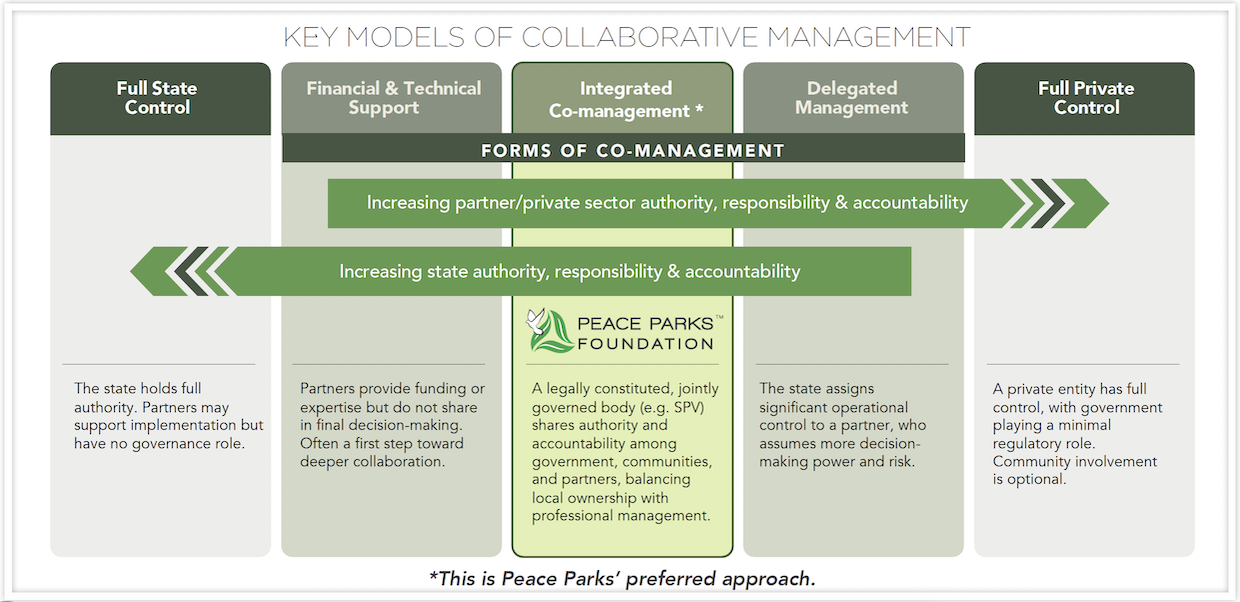
Over the past 20 years, there has been a significant shift in how protected areas in Africa are managed where non-profit organisations are involved. Where the trend was for partners to provide technical and financial support, or to assume full responsibility, more collaborative and inclusive management partnerships are now being established. While these conservation alliances may differ slightly based on local context, the fundamental concept is that decision-making authority is shared between government, the people living in the landscape, NGOs and other relevant stakeholders.
Peace Parks fully embraces the integrated co-management model. We believe that:
- A strong relationship of trust between governments, local communities and NGOs is essential. This is anchored by the creation of special purpose vehicles that provide structure and drive implementation of collaborative management partnerships.
- All parties must commit to a shared vision for the protected landscape through collaborative and long-term strategic business plan.
- Agreements need to be clear and detailed, with each partner’s roles and responsibilities clearly outlined.
- Agreements must be long term and supported by sustainable financial strategies.
- Management and implementation teams should consist largely of local representation.
- Key performance indicators must be identified and monitored to enable transparency collaborative performance reviews and an adaptive management approach
What is a Special Purpose Vehicle?
An SPV is a legal entity designed for specific purposes – in this case, to manage a protected area. It ensures financial risk management, accountable asset handling, and involves key stakeholders like local communities and government officials in decision-making. This structure promotes good governance.
The model assigns the right to develop and manage protected areas, by following agreed infrastructure, staffing, wildlife conservation, and tourism management plans. It also provides a unified staffing structure for efficiency, clear hierarchy, and effective communication, while preserving the government’s law enforcement responsibilities. Government staff may be seconded to the SPV but retain their legal powers.