Home › Ecological Linkages
Ecological Linkages
Connecting protected areas. Strengthening shared landscapes.
Ecological linkages connect protected areas, enabling functional, robust landscapes.
They support shared land-use planning, wildlife movement and the coexistence of people and nature across large areas. Protected areas are the building blocks of conservation, but their long-term success also depends on what happens beyond their boundaries. Ecological linkages provide a framework for planning and managing these shared spaces so that protected areas remain connected and the
wider landscape can function over time.

By 2030, Peace Parks aims to operationalise seven priority ecological linkages across five transboundary landscapes.
How an ecological linkage works
in practice
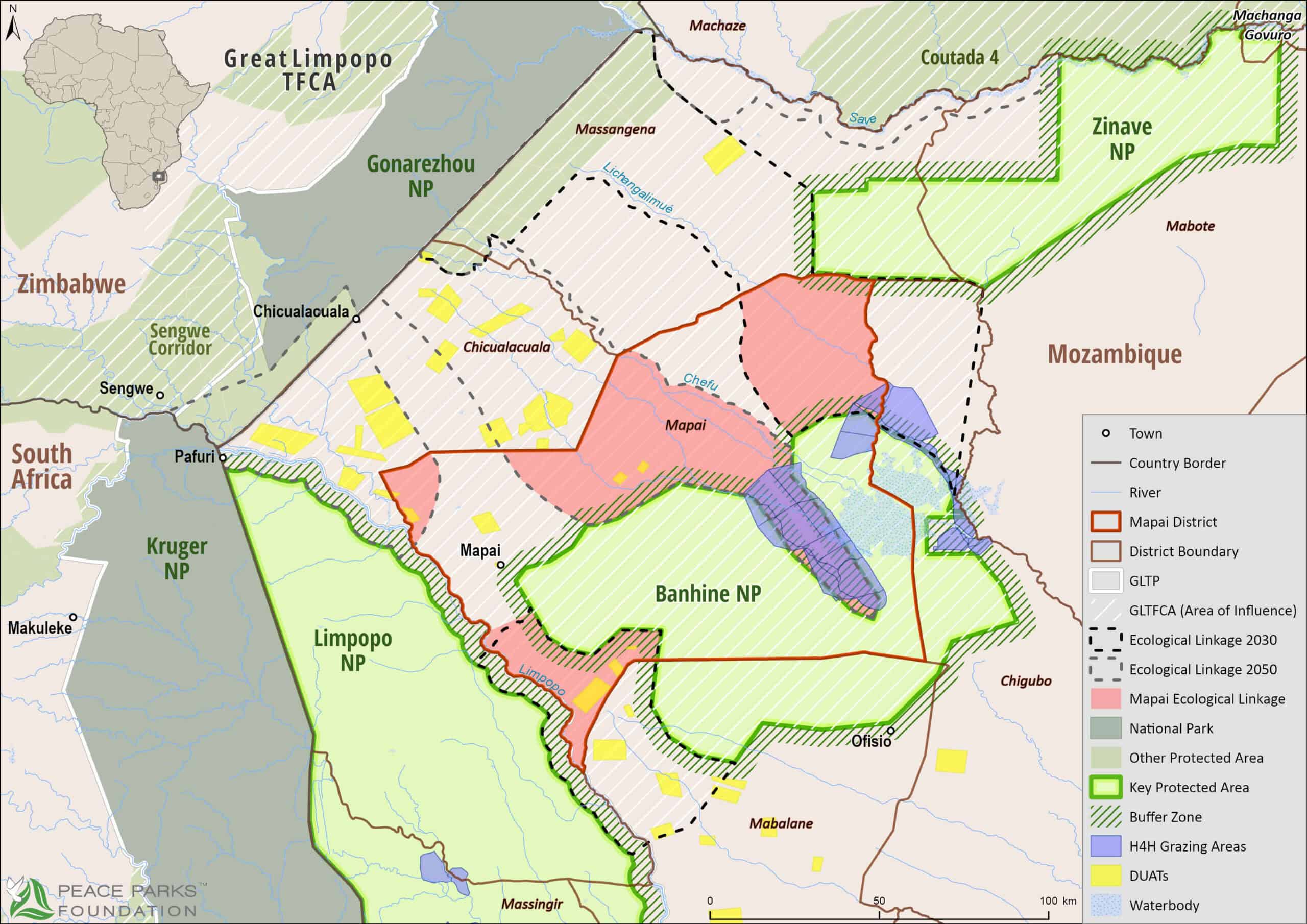
Peace Parks’ work in Mapai District, Mozambique, demonstrates how this can operate in practice. The 11 678 km² district land-use plan formally recognised ecological corridors while also providing for farming, aquaculture, forestry, tourism and community development. It was developed through a process involving national, provincial and district authorities, community leaders and land-use specialists.
Seven priority ecological linkages
Sioma - Kafue
This linkage connects Zambia’s Sioma Ngwezi and Kafue national parks in the Kavango Zambezi landscape. These linkages support the movement of elephant, buffalo, zebra, carnivores and other migratory species including birds.Â
Simalaha - Kafue
This linkage connects Botswana, Namibia,and Zambia within the Kavango Zambezi landscape. These linkages support the movement of elephant, buffalo, zebra, carnivores and other migratory species including birds.Â
Limpopo - Banhine
Limpopo and Banhine are joined through an ecological linkage connecting Mozambican protected areas with South Africa’s Kruger National Park. These connections anchor large-scale elephant and predator movement.
Banhine – Zinave - Gonarezhou
This linkage connects Mozambique’s national parks with Zimbabwe’s Gonarezhou within the Great Limpopo landscape. These connections anchor large-scale elephant and predator movement.
Futi Corridor
Proclaimed in 2011, this landscape strengthens management collaboration between Maputo National Park and Tembe Elephant Park.
Maputo (Marine) - iSimangaliso
The coastal and marine system extends between Maputo National Park and iSimangaliso Wetland Park, protecting coral reefs, turtle-nesting beaches, estuaries and other habitats across the international boundary.
Nyika - Vwaza
The Nyika – Vwaza connection functions as an ecological linkage through watershed connectivity, shared ecosystem services, and co-management of montane and riparian systems.

How ecological linkages are strengthened
Shared land-use planning
Local governance
Local governance
Sustainable farming and livestock management
Wildlife movement and monitoring
Habitat and natural-resource management
Economic opportunity
Part of a larger conservation system
Ecological linkages connect the key protected areas that anchor Peace Parks’ five priority transboundary landscapes.
Together, these protected areas and linkages create the scale required to protect biodiversity, strengthen climate resilience and support the people and economies that depend on healthy natural systems.