About Peace Parks
Our Shared Vision
Our vision is one of connected landscapes where people and nature thrive together.
Achieving this starts with professionally managed protected areas, supported by capable institutions and long-term partnerships across the wider landscapes that surround them.
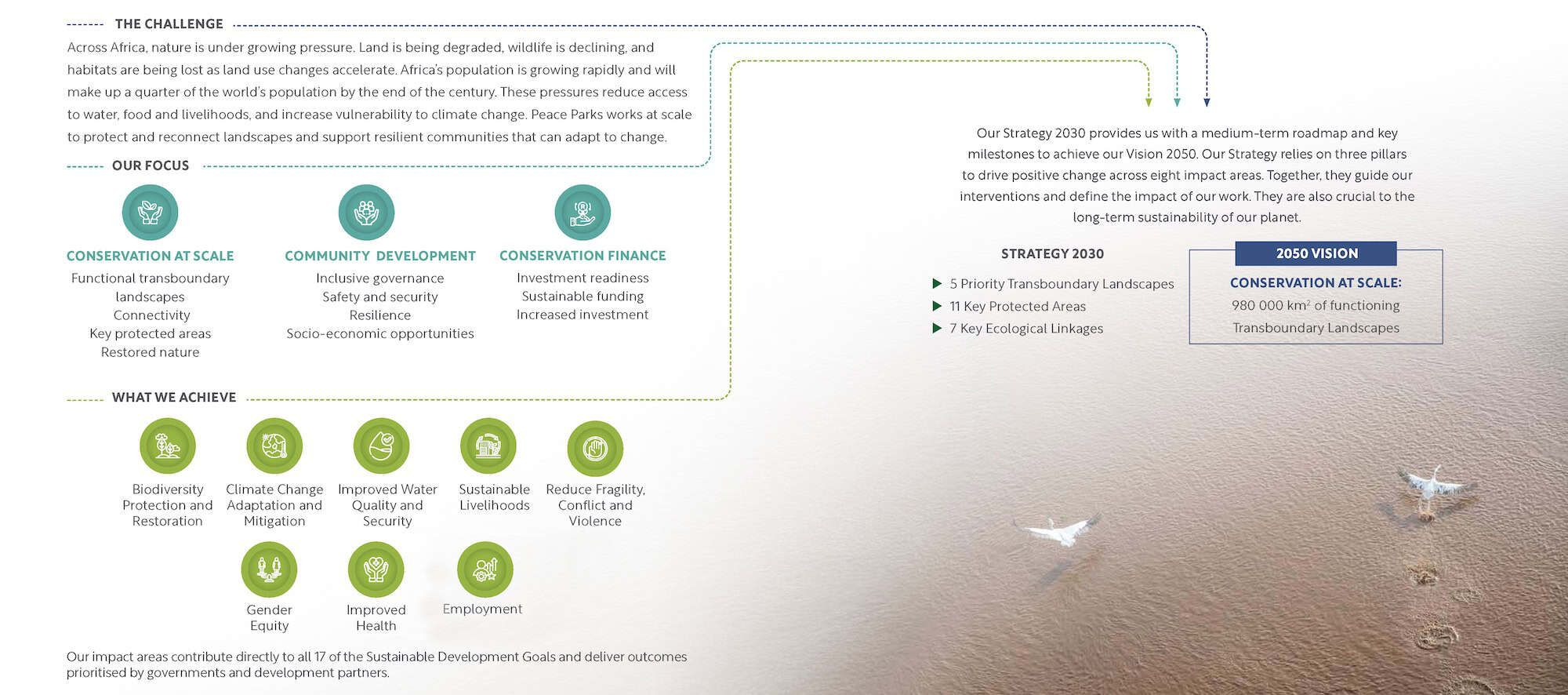
By 2030, Peace Parks is focusing its work across five priority transboundary landscapes, anchored by 11 key protected areas and strengthened through seven ecological linkages.
Our longer-term vision is to help secure connected conservation landscapes across close to one million square kilometres of southern Africa.
Why conservation at scale matters
Wildlife, rivers and natural systems do not stop at the boundaries of a national park or a country. Conserving them requires cooperation at the scale at which they function.
Peace Parks works across three interconnected parts of this geographical system:
- Transfrontier landscapes
- Protected areas
- Ecological linkages
Together, these three elements allow conservation to extend beyond isolated protected areas and function across the wider landscape.
“The protected areas are the building blocks.
The landscapes are the vision.”
Our Origin Story
Peace Parks was founded in 1997 on a bold idea: that Africa’s shared natural landscapes could strengthen peace and cooperation between neighbouring countries.
The vision was championed by Dr Anton Rupert, President Nelson Mandela and HRH Prince Bernhard of the Netherlands. They understood that the future of Africa’s wildlife and landscapes depended on countries working together to protect what they shared.
From the outset, Peace Parks worked at the invitation of governments. Since then, Peace Parks’ role has grown from supporting the establishment of transfrontier conservation areas to taking long-term responsibility for protected-area management through integrated co-management.
What makes Peace Parks different
Peace Parks works with governments to manage protected areas through long-term (20+ years) public-private partnership agreements. Our preferred approach is integrated co-management, bringing governments, Peace Parks, local communities and other key stakeholders together in the management of protected areas.
Through these partnerships, dedicated management institutions are established to provide the professional capacity, accountability and long-term financial foundations needed to manage protected areas effectively.
For almost three decades, governments across southern Africa have entrusted Peace Parks with increasingly significant, long-term, shared responsibility for park management. Those relationships have been built on Peace Parks’ sustained commitment to the landscapes and communities where it works.
Working alongside governments
Third largest conservation operator in Africa by protected area mandates
Protected through long-term partnerships
Timeline
May 1990
An idea takes shape
Dr Anton Rupert, then President of WWF South Africa, and Mozambique’s President Joaquim Chissano discuss joining protected areas across the two countries’ borders.
September 1991
Exploring the potential
A feasibility study is presented to Mozambique, prompting further research into the political, socio-economic and ecological impacts of cross-border conservation.
June 1995
International support follows
The Global Environment Facility of the World Bank backs the emerging transfrontier conservation concept, helping build momentum for its development.
June 1, 1996
From parks to landscapes
A World Bank report helps shift the vision from individual cross-border parks to connected transfrontier conservation areas spanning whole landscapes.
August 1, 1996
A regional idea gains momentum
Mozambique, South Africa, Zimbabwe and Eswatini agree to advance transfrontier conservation together, marking an importnat step toward cooperation.
February 1, 1997
Peace Parks Foundation is established
Founded by President Nelson Mandela, Prince Bernhard and Dr Anton Rupert, Peace Parks is established to turn the vision of transfrontier conservation into reality.
May 2000
A vision crosses borders
Botswana and South Africa open the Kgalagadi Transfrontier Park, Africa’s first transfrontier park, bringing cross-border conservation to life.
December 2002
Three countries commit to Great Limpopo
Mozambique, South Africa and Zimbabwe establish Great Limpopo, with Peace Parks supporting efforts to turn cross-border cooperation into a shared landscape.
August 2011
Five countries establish KAZA
Angola, Botswana, Namibia, Zambia and Zimbabwe establish the Kavango Zambezi Transfrontier Conservation Area (KAZA), following years of Peace Parks support in developing the transfrontier initiative.
2015–2016
Deepening the partnership
Peace Parks expands its role through long-term partnerships with governments to restore and jointly manage protected areas within transfrontier landscapes.
2017
Restoring wildlife at scale
The Government of Mozambique and Peace Parks launch a major rewilding programme in Zinave National Park to rebuild wildlife populations and restore ecological integrity.
2022
Rhinos return to Zinave
The Government of Mozambique and Peace Parks return rhinos to Zinave after 40 years, making it Mozambique’s only national park with the Big Five.
2023
A New model for park management
The Government of Malawi and Peace Parks sign a 20-year agreement to co-manage Nyika National Park and Vwaza Marsh Wildlife Reserve through an independent Trust, bringing government, communities and partners together in shared management.
Today
Conservation at scale
Today, Peace Parks continues to expand its conservation impact, working towards a long-term vision of 17 functional landscapes across southern Africa by 2050.